Blog / Techniques
Marinades vs. Dry Rubs: When to Use Each and Why
July 9, 2025 · by Priya Anand
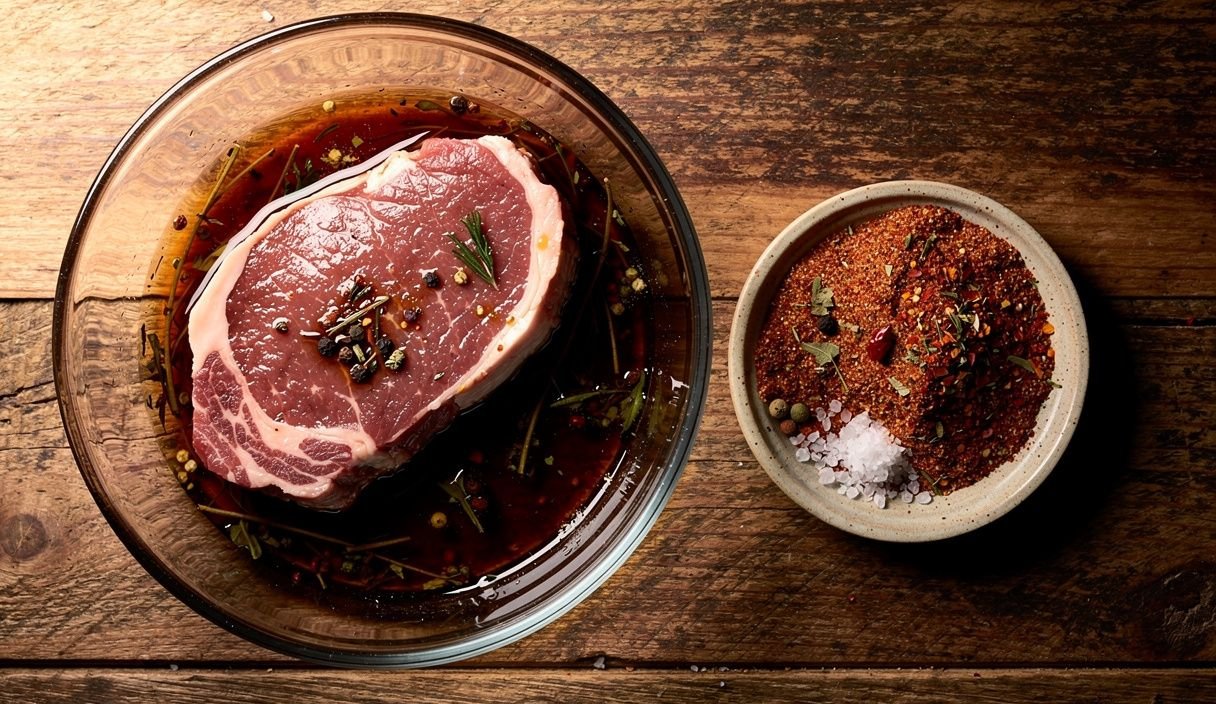
It is common to see marinades and dry rubs treated as two flavors of the same idea, but they work through almost entirely different mechanisms and are suited to different cuts and cooking methods.
A marinade is a liquid mixture, typically combining an acid like vinegar or citrus, an oil, and aromatics like garlic and herbs. The acid does most of the heavy lifting, breaking down surface proteins and tenderizing thinner cuts, while the oil helps carry fat-soluble flavors from herbs and spices into the meat. Marinades are most effective on thinner, leaner cuts like flank steak, skirt steak, or chicken breasts, where the flavor and tenderizing effect can actually penetrate meaningfully in a reasonable soak time of a few hours to overnight.
Dry rubs work through an entirely different route. A mixture of salt, sugar, and spices sits directly on the meat's surface, and the salt draws moisture out briefly before being reabsorbed back into the meat, carrying dissolved seasoning with it in a process similar to a dry brine. Rubs are the standard choice for thicker cuts destined for low and slow cooking, like pork shoulder, brisket, or ribs, because they build a concentrated, seasoned crust, known as bark, that develops over many hours of smoke exposure, something a wet marinade would actually work against by keeping the surface too moist to form a proper crust.
One common mistake is marinating a cut for far too long, assuming more time means more flavor. Beyond roughly 24 hours, the acid in most marinades starts to actively break down surface texture, turning meat mushy rather than tender, particularly with more delicate proteins like chicken or fish which can go mushy in as little as a few hours in a strongly acidic marinade.
There is also a hybrid approach worth knowing: a dry brine followed by a rub. Salting a cut hours ahead, letting it sit uncovered in the refrigerator, then applying a spice rub closer to cook time gives you the moisture retention benefits of brining along with the crust-building benefits of a dry rub, without the surface wetness a liquid marinade would introduce.
As a simple decision rule, reach for a marinade when you are cooking a thinner cut hot and fast and want both tenderizing and flavor penetration, and reach for a dry rub when you are cooking a thicker cut low and slow and want a concentrated, bark-building seasoned crust. Using the wrong one for the job will not ruin your barbecue, but matching the technique to the cut consistently produces better results.